Description
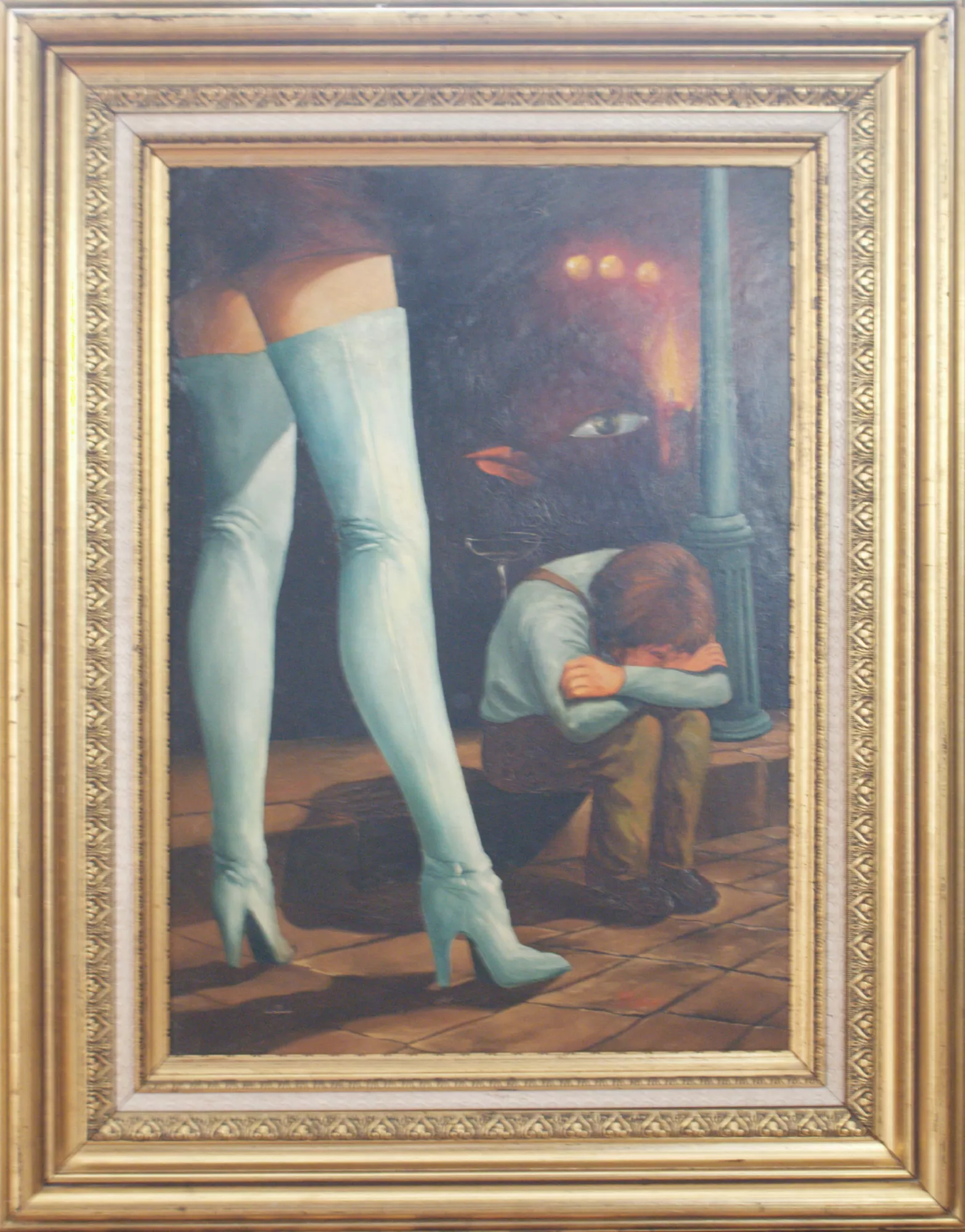
In Vice, Aly Mohsen Abdel creates a work of strong emotional and symbolic impact, capable of addressing the viewer’s conscience directly. The scene is set in a nocturnal urban environment: a crying child sits on a sidewalk beneath a streetlamp, curled up and fragile, becoming the moral and emotional focal point of the painting. In the foreground appear the legs of a woman wearing white boots and a miniskirt—an anonymous, fragmented presence that alludes to the adult world, to vice, and to moral indifference.
In the background, a series of highly symbolic elements emerge: a glass, lips, eyes, and a lit candle. The candle illuminates three glowing spheres, a clear reference to hope, charity, generosity, and divine providence, standing in stark contrast to the moral degradation suggested by the scene. Light thus becomes a metaphor for redemption and possibility, even within the darkest contexts.
The work is inspired by a real episode experienced by the artist during his time in Paris: an encounter with a neglected child whose mother was more attracted to nightlife than to her parental role. This episode intertwines with Mohsen Abdel’s own biography—at just sixteen years old, he began living on his own and found human and emotional support precisely among those marginal female figures often judged harshly by society. The painting therefore becomes a profound reflection on the thin boundary between vice and humanity, between moral condemnation and compassion.
Light, predominantly artificial and nocturnal, is used as a compositional device to separate planes and establish visual hierarchies. The streetlamp defines the area occupied by the child, while the surrounding zones remain immersed in compact shadow. The color palette is dominated by dark and cool tones, punctuated by precise chromatic and luminous accents that concentrate attention on key elements.
From a technical standpoint, the painting demonstrates controlled brushwork, alternating smooth, refined surfaces with softer, blended passages. The rendering of materials — textiles, skin, urban surfaces, and artificial light — is achieved through tonal variation and a measured handling of pictorial matter, serving the narrative clarity of the image.
The frame, featuring a gilded mat and classical decorative finish, defines the boundary of the work and reinforces its visual structure, creating a clear separation between the represented scene and the surrounding environment and supporting the reading of the painting as a self-contained, autonomous image.


